Chargement en cours ...
Par type de document :
Par date :
Par région :
 Recherche, description et conservation de sites de reproduction de Leucorrhines (Leucorrhinia albifrons, Leucorrhinia caudalis, Leucorrhinia pectoralis) en Sarthe
Espèce·s liée·s :
 Recherche des Zygoptères patrimoniaux (Agrion de Mercure Coenagrion mercuriale, Agrion gracieux Coenagrion pulchellum, et Leste dryade Lestes dryas) sur le bassin versant de la Braye et propositions de gestion
Espèce·s liée·s :
Martinia
Espèce·s liée·s :
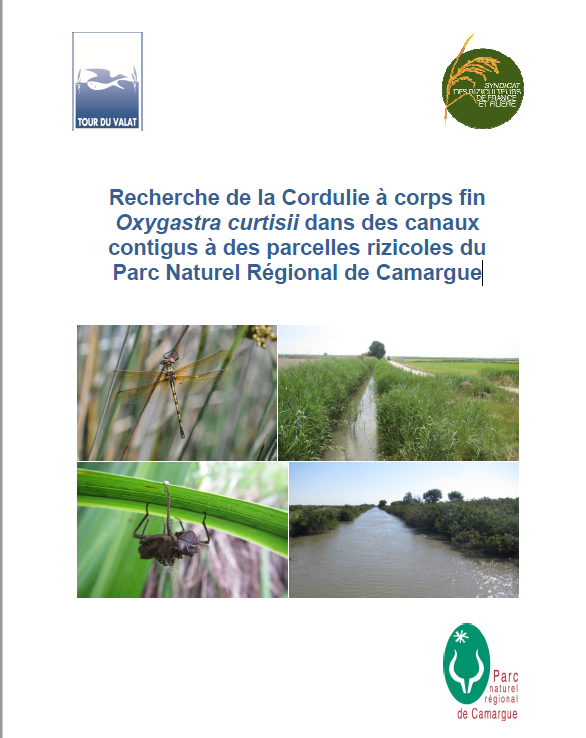 Recherche de la Cordulie à corps fin Oxygastra curtisii dans des canaux contigus à des parcelles rizicoles du Parc Naturel Régional de Camargue
Espèce·s liée·s :
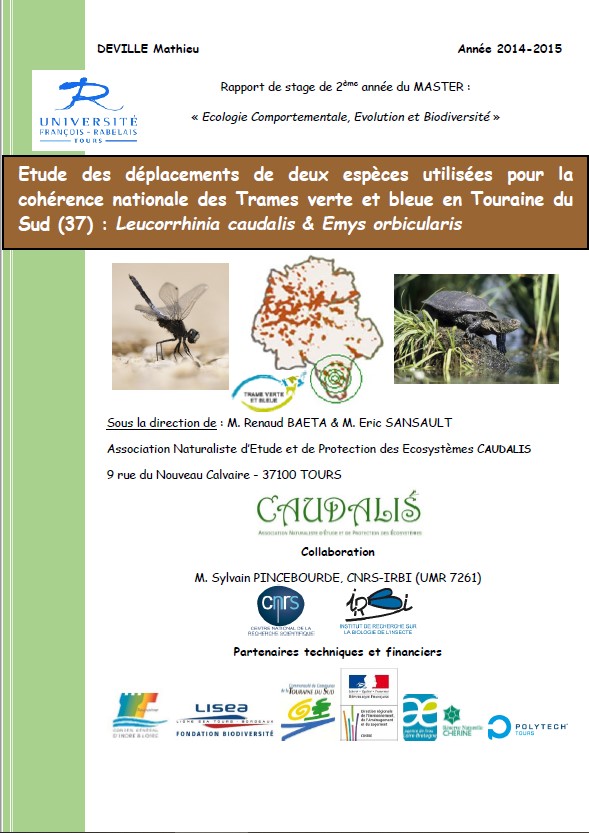 Etude des déplacements de deux espèces utilisées pour la cohérence nationale des Trames verte et bleue en Touraine du Sud (37) : Leucorrhinia caudalis & Emys orbicularis
Rapport de stage de 2ème année du MASTER : « Ecologie Comportementale, Evolution et Biodiversité ». Université François Rabelais - Tours
Espèce·s liée·s :
 Bulletin Annuel de Liaison du Collectif d’Études Régional pour la Cartographie et l’Inventaire des Odonates de Normandie (CERCION)
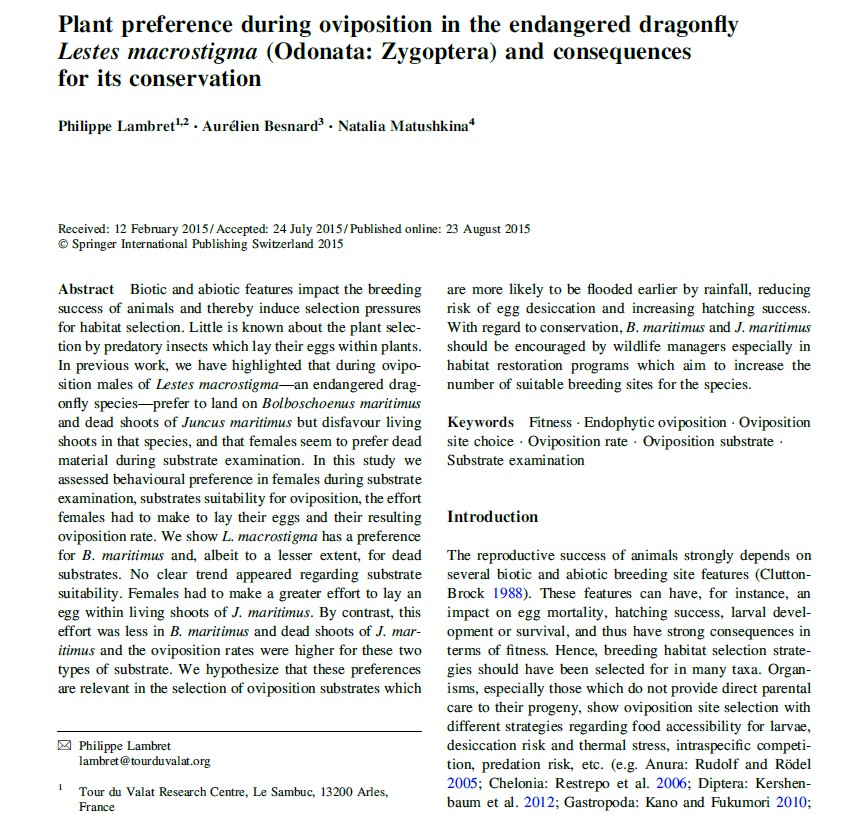 Plant preference during oviposition in the endangered dragonfly Lestes macrostigma (Odonata: Zygoptera) and consequences for its conservation
Biotic and abiotic features impact the breeding success of animals and thereby induce selection pressures for habitat selection. Little is known about the plant selection by predatory insects which lay their eggs within plants. In previous work, we have highlighted that during oviposition males of Lestes macrostigma—an endangered dragonfly species—prefer to land on Bolboschoenus maritimus and dead shoots of Juncus maritimus but disfavour living shoots in that species, and that females seem to prefer dead material during substrate examination. In this study we assessed behavioural preference in females during substrate examination, substrates suitability for oviposition, the effort females had to make to lay their eggs and their resulting oviposition rate. We show L. macrostigma has a preference for B. maritimus and, albeit to a lesser extent, for dead substrates.
Espèce·s liée·s :
 Impact du paysage sur la structure génétique spatiale et la diversité de Coenagrion mercuriale dans le nord de la France (EN)
Loss and fragmentation of habitat is a current main cause of biodiversity loss in freshwater habitats. Odonates (dragonflies and damselflies) depend on these habitats to complete their development. Fragmentation may be a particular threat for odonates because it generates a network of small habitat patches within which populations could suffer from isolation and loss of genetic diversity. The southern damselfly Coenagrion mercuriale is categorized on the IUCN red list as Near Threatened, largely because of population fragmentation and demographic declines associated with changes in land use. Small populations at the margin of this species’ range are of particular concern because they would be prone to detrimental effects of habitat fragmentation if this species were a poor disperser.We sampled C. mercuriale in 16 habitat patches (localities) at 4 main sites in the department of Pasde-Calais in northwestern France to quantify factors that affect dispersal and genetic diversity. Specimens were genotyped at 12 microsatellite loci to quantify genetic diversity, genetic differentiation, and the potential effect of landscape variables on genetic differentiation, and to detect any potential source–sink structure. Habitat separation had a limiting effect on dispersal by C. mercuriale, resulting in 3 main genetic clusters and weak divergence at the main site of Vallée de la Course. Genetic ifferentiation was low in each main site, implying that the localities within sites were connected at scales of up to ∼2 km, albeit with some evidence for isolation at the more isolated localities. Given the degree of isolation of some areas and a lack of apparent genetic mixing in the intervening populations, any movement among the most distantly separated sites must have occurred some time ago. We identified barriers to dispersal, such as woodland, but detecting an unambiguous effect of certain variables, such as urbanization, was difficult because many landscape eatures were highly correlated.
Espèce·s liée·s :